.png)
Fletcher Byrd: Is my life more than my sport?


Fletcher during his college baseball career at Keiser University.
I think back to when I was a 21-year-old junior left-handed pitcher at Keiser University, an NAIA program in West Palm Beach, FL. I remember that Sunday afternoon with my parents in town visiting me, breaking down crying on that empty baseball field in front of them. My parents were helping me through a rough patch of outings from that weekend's series. My mission was to go out to the field to do more drills and practice when nobody else would be present at the field. As had been the case in the past, that practice session quickly turned into a session of rage, sadness, and hurt. Despite finishing with the best team ERA that season and having a prominent role in the bullpen for Keiser, all I saw myself as, in that moment, was a failure.
I remember these moments like it was yesterday. The angry outbursts, the throwing of my glove, the screams of disgust, and the tears. This wasn’t the first time this happened that season. A blown save against our rivals led to me walking 100 yards into the woods surrounding the ballpark and screaming curse words at myself, as my teammates looked on in utter shock. Everything: my happiness, my joy, my mood, my sleep, my self-confidence, my self-image, my entire worth and value…depended upon the outcome of each game I played. If it went well…I was on top of the world. If it went poorly…all hell would break loose.
The previous season, I was up the road in Leesburg, FL, pitching at a Juco called Lake Sumter St. We had a Fall scrimmage against our local rivals to determine the winner of our annual Fall Classic, an exhibition to help excite the rather dull moments of Fall training camp. To me, on the mound, it was Game 7 of the World Series. I didn’t have my best outing that day, and as you can imagine, it meant a steady stream of outbursts and tears. I remember vividly parking my 2004 Ford Explorer at a park by the lake, opening up the trunk, sitting in the back, and just beginning to cry by myself. I always tried to put on this mask of stoicism and confidence around others…but in the moments of struggle, I turned into a completely different person. In my mind during those dark moments, I thought to myself: If I wasn’t meant to be the next great baseball superstar, what was the point of playing…what was the point of living?

Mental health isn’t a one-size-fits-all ballcap. What one athlete can tolerate may be too much for another athlete to handle. What someone sees on the outside as a blessing and dream to be playing college sports, could in fact be a curse to the one having to live out that experience. In this comparison-filled era we all live in (thanks to social media), it’s a stark reminder that one's mental health is truly one's own journey, and nobody else’s.
As a current 29-year-old pro baseball scout, I’ve seen the effects our athletic journeys can have on us, both physically and mentally. Since our youth days playing little league, Pop Warner, or tee ball, we learned to associate winning with good, and losing with bad. When you hit the game winning homerun, everyone around you is happy, joyful, smiling, and patting you on the back. When you strike out to end the game, everyone is sad, angry, upset, and disappointed. The post-game huddles are worse, the car rides back home are worse, and those late Sunday night homework sessions are worse. To someone like myself that’s always strived to make everyone around me happy, the sudden change in mood that defeat can bring upon your family, friends and coaches can leave a huge negative imprint on one's mental health.

We, as athletes, grow up and begin to dedicate serious time, money, and energy to every aspect of our sports. To those like myself who take a personal account of every expensive piece of equipment, tournament fee, or hotel bill thrown our parents' way to allow us to pursue our passions, it can feel like an unpaid debt. “Mom and Dad bought me a $300 glove and bat for my birthday; I'd better perform well to make it worthwhile”. “My Grandparents paid for private lessons and a summer camp; I'd better become the next Aaron Judge or Kyrie Irving”. “I just turned down hanging out with friends to instead hit the weight room and do extra drills to perfect my craft… I'd better be perfect in the big game tomorrow”. All these weights of expectations begin to pile up internally, to the point where even a good performance ends up not feeling good enough.
You fast-forward to college, and you’re one of the lucky ones to have gotten the chance to play at the next level. Now the expectations, stress, and internal pressures really begin to reach their highest levels. “Tuition was $25K this calendar year. I'd better make it to the pros to help repay my parents”. “Only a certain number of freshmen will even be on the team come the Spring time, I better train extra hard, avoid social outings, and be totally dedicated to my craft in order to outwork and outperform the competition”. “The coach just brought in 4 new players from the transfer portal for my position. I'd better try my hardest to show the coaches why I matter to them.
You may be reading this and thinking: “Doesn’t this all come with the territory of any high-achieving sport or activity?” And you’d be correct in believing it does. But this isn’t about telling you anything new here…it’s about replaying the very real messaging your mind reads internally at every step of the athletic journey.
The very reality of sports is that achieving victory on the athletic field was never meant to align with good mental health practices. The millions of sports cliches and quotes were never meant to ensure that at the end of the day, your mind was in a healthy place. Most times, what we hear from our parents, friends, teammates, coaches, and ourselves is doing everything but ensuring our mental health is taken care of. “Play through pain”, “practice makes perfect”, “Better never stops”, “Hard work beats talent when talent doesn’t work hard” are all examples of quotes shoved down every athlete's throat since the time they were little. What if these sayings that are meant for us to become better athletes weren’t meant to help us handle the very real mental health issues sports can bring upon us? What if each quote reinforced this idea that we are only worth what we accomplish on the athletic stage?
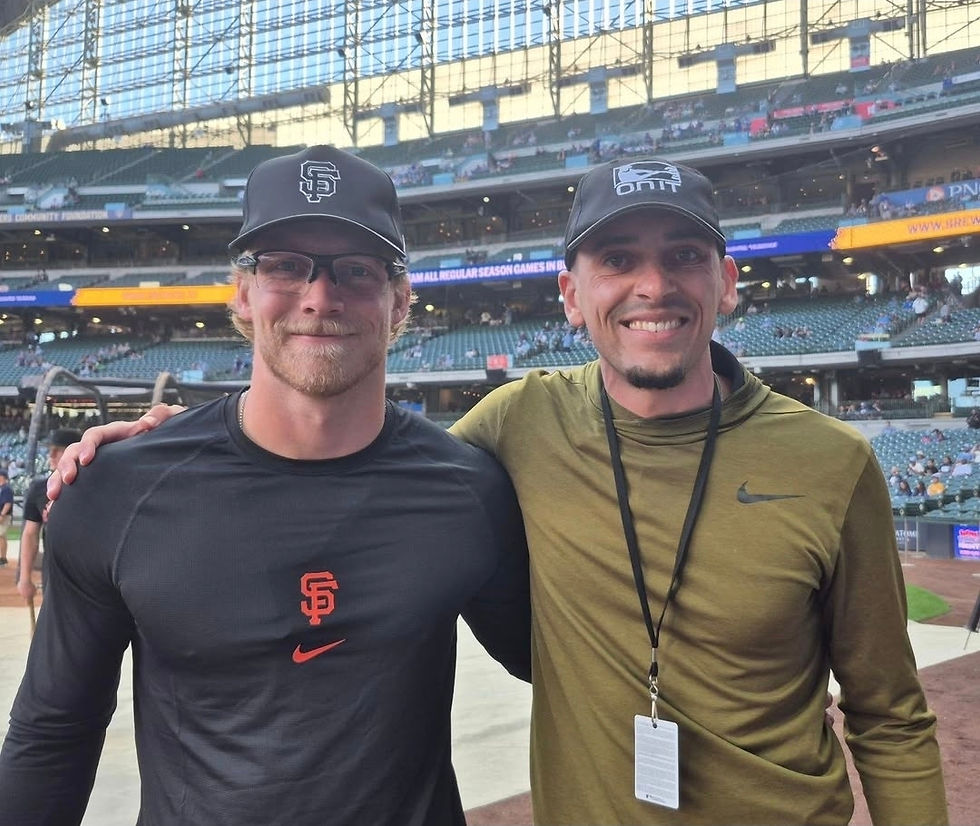
Despite what anyone may tell you within the world of sports, you are more than what you achieve on the field, and your life is worth more than the number of points you score, touchdowns you catch, or home runs you hit.
You’re more than that new Nike or Adidas tracksuit with that nice travel ball, high school or college logo stitched onto it. You’re worth more than the tournament fees, the expensive equipment, private lesson costs and tuition fees. Your life is worth more than the social media presence you may have gained from your sporting successes or the accolades and trophies on your dresser. Your life is worth so much more than any of those things…because the harsh reality is that those things can be taken away from you in a flash, and for all athletes, our careers at some point in time will come to an end.
Contrary to popular belief, you can maximize your athletic abilities and potential without making your sport your entire identity. Of course, sports will always serve as a part of our identities as athletes, but it doesn’t have to become our entire identity. No matter if you get cut from JV or go on to play professionally, we are all human beings, created as complex and beautiful creations, fearfully and wonderfully made. To strip down our incredible selves to just “athlete” goes against our human DNA. We were never meant to be boxed into one singular thing. We were meant to soar, both physically and mentally!

Before you ever wanted to play a sport, or become an athlete, or dream of reaching the pros…what were you? Who were you? What made you, you? If you’ve never been allowed to explore past your athletic identity…then begin right now by asking: “Who am I?”
What do I enjoy doing outside of my sport? Who do I enjoy being outside of “athlete”? What interests do I have beyond sports? What gets me up out of bed besides the game on the schedule or the achievements of yesterday's match?
No matter if you’re 14, 24 or 54 yrs old… begin asking yourself these questions and allow your brain to see yourself as much more than your jersey number or statistical value! If you stunk at shooting free throws in last Friday’s game, which cost your team the win, but you’re tremendously talented at art, take time and paint, create something amazing, and place that amazing talent of yours to paint in the same tier as your athletic ability!

Harmful self-talk was always my kryptonite on the baseball field, as I’m sure is the case with many of you reading this. Good was never good enough in my mind, and bad was always the end all be all. I had such poor self talk because all I saw in myself was “athlete”…and as long as there was a better place on the team to achieve, a stat to improve upon, a bad outing that needing fixing, or a level I hadn’t yet reached yet, my self talk would always be harsh and critical…to the point of seeing myself cry my eyes out that Sunday afternoon at Keisers baseball field, with my parents holding me in their arms, asking me why I thought I was such an awful player.
To every athlete who's read this far…please love yourself! Our minds, more than anyone else, can set the trajectory of our lives in a positive and uplifting manner. We can either be our best friend or worst enemy inside our minds. Look beyond your athletic talents and identity, and find what makes you truly special…and love the heck out of that version of you every single day, even when the results on the field don’t go your way. So that one day, regardless of what the final score reads, your mind will see the score of life and always jump to the same conclusion: You’re a winner!

Beyond the field, the statistics, and the uniform, you are still you.
Love,
Fletch


Comments